
What does hyaluronic acid do
The ingredient half a category is named after held up once in eight.
Of 8 milestones proposed for hyaluronic acid, 1 held up. The hydration figures that circulate come from a serum with four other actives and no placebo.
Hyaluronic acid, listed as sodium hyaluronate on most labels, is the ingredient a whole shelf is named after, and the one that holds up worst when you check the evidence: of 8 efficacy milestones proposed for it, 1 survived. The hydration numbers you see quoted, +134 % fifteen minutes after applying and +55 % at six weeks, come from a serum with four other actives in it.
Key takeaways
- Of 8 efficacy milestones proposed for sodium hyaluronate, 1 was confirmed. Retinol: 7 of 8.
- The most quoted hydration figures, +134 % at 15 minutes and +55 % at 6 weeks, were measured on the left cheek of 40 people using a finished serum.
- That serum carries four other actives, the trial had no placebo and participants also wore sunscreen: the figures describe the serum, not the ingredient.
- The one milestone that held was measured on the face, around the eye, at day 60, and only for the two lightest molecular weights.
The numbers everyone quotes
The hydration figures that travel with hyaluronic acid come from one trial, published in 2021. Forty people with photoaged skin used a hyaluronic acid serum twice a day for six weeks, and an instrument measured the water in the skin of the left cheek.
Fifteen minutes after the first application, the reading was 134 % above where it started. The later readings were taken on clean skin, with no product on it: 15 % above the start at two weeks, 29 % at four and 55 % at six. Most of that first jump is the product sitting on the surface. The curve after it is the part that tells you what stays.
Why those numbers belong to the serum
The serum in that trial is not hyaluronic acid on its own. Besides hyaluronic acid at several molecular weights, it carries a complex of four other actives, in proportions the maker does not publish. The trial had a single arm and no placebo, so there is nothing to compare the curve against. Participants also used a sunscreen and their own cleanser for the six weeks, and the study was funded by the company that makes the serum.
None of that makes the numbers false. They are real, and they are reported correctly. They are the numbers of a finished formula, and nouyu's research refused to count them as a milestone of the ingredient for exactly that reason.
Why one in eight
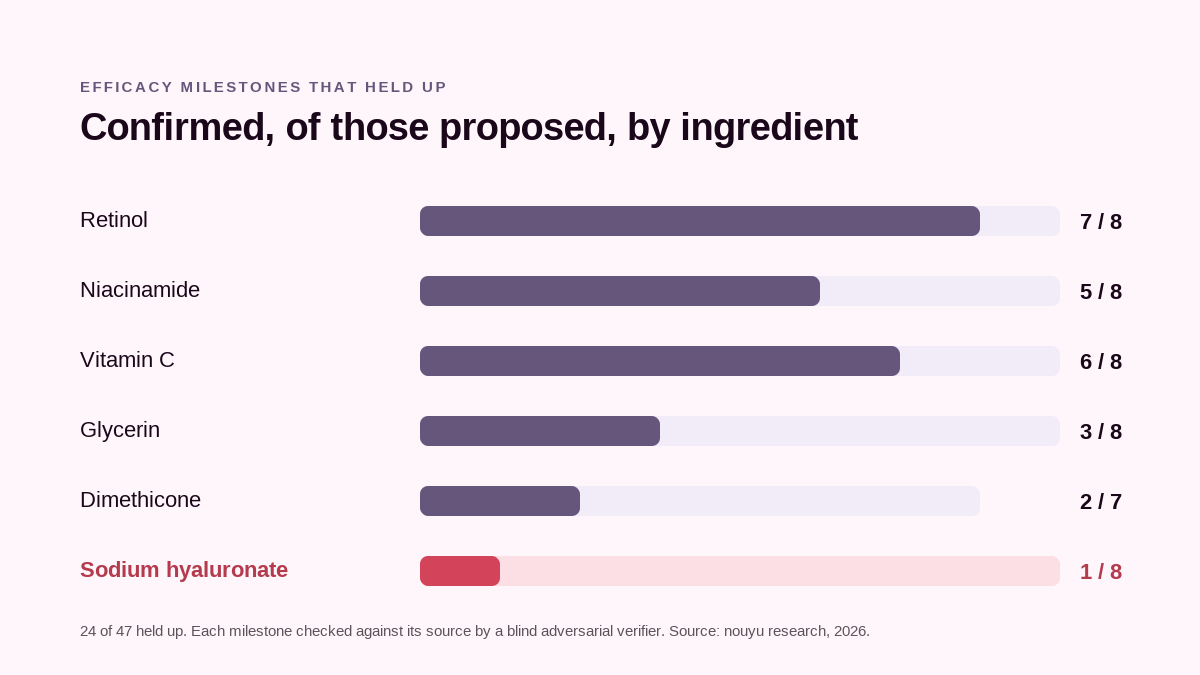
nouyu proposed efficacy milestones for six common ingredients, 8 for each of them and 7 for dimethicone, and had every one checked against its source, milestone by milestone, by a blind adversarial verifier. 24 of the 47 held up. Sodium hyaluronate came last: 1 of 8.
The 23 that fell all fell for the same reason. No study was fake and no number was miscopied. The trial tested a finished cream, and the claim was made about one ingredient inside it. A cream with sodium hyaluronate in it can perform well, and that still says nothing about what the sodium hyaluronate did.
The pattern runs in one direction. The more an ingredient counts as an active, the better it holds up, because actives get studied on their own: a registration or a patent depends on it. Humectants and supporting ingredients are almost only ever studied inside a formula. Glycerin held 3 of 8. Retinol held 7.
The one that held
The milestone that survived comes from a controlled trial with 76 participants, run on the face, around the eye. Each person used a cream with 0.1 % hyaluronic acid on one side and the same cream without it on the other, and the study compared five molecular weights, from 50 to 2,000 kDa. That design is why it counts: the only difference between the two sides is the ingredient.
At day 30 the instruments found no difference in wrinkle depth. At day 60 they did, and only for the two lightest weights, 50 and 130 kDa. Hydration and elasticity readings were better than the vehicle for every weight.
That is a narrow result, and a useful one. It says which version, which concentration, which part of the face and how long. It does not say that any product with hyaluronic acid on the front of the box will do the same.
What this means for the bottle in your hand
The name on a product tells you what the brand wants you to notice, not what does the work. A trial on a finished serum is evidence about that serum. If you want to know whether a product suits you, the question is less "what is in it" and more "what happened to people whose skin behaves like yours". That is the question nouyu answers, from reviews read by skin type, with the denominator in view: see what people with your skin type said.
Reviews have the same problem as trials, from the other side: most of them never say whose skin they describe (are Amazon reviews fake). And if you are comparing timelines across ingredients, retinol is the one with the most evidence on its own, with windows from days to months depending on what you measure: how long retinol takes to work.
The number to keep
1 of 8 milestones confirmed for sodium hyaluronate, against 7 of 8 for retinol. When a hydration figure for hyaluronic acid comes from a finished serum with other actives and no placebo, it is a number about that serum. The one result that isolates the ingredient is day 60, on the face, for the two lightest molecular weights.
Frequently asked questions
Does hyaluronic acid actually work?
Measured on its own, the evidence is thin. Of 8 milestones proposed for it in nouyu's review, 1 held up: a difference in wrinkle depth around the eye at day 60, for the two lightest molecular weights. The hydration figures usually quoted come from a serum with four other actives and no placebo.
Where do the 134 % and 55 % hydration figures come from?
From a 2021 open-label trial of a commercial hyaluronic acid serum, measured on the left cheek of 40 people, with no placebo. The serum also contains four other actives, so the figures describe that formula, not hyaluronic acid on its own.
What is the difference between hyaluronic acid and sodium hyaluronate?
On an ingredient list, hyaluronic acid usually appears as sodium hyaluronate, its salt form. The research nouyu reviewed tracks it under that name, and the one milestone that held up used a cream with 0.1 % hyaluronic acid at five molecular weights.
Hyaluronic acid vs glycerin: which one has more evidence?
On their own, neither has much, because both are almost always studied inside a finished cream. In nouyu's review glycerin held 3 of 8 proposed milestones and sodium hyaluronate held 1 of 8. Actives such as retinol, at 7 of 8, are the ones studied in isolation.
Sources
- Draelos ZD, Diaz I, Namkoong J, Wu J, Boyd T. Efficacy Evaluation of a Topical Hyaluronic Acid Serum in Facial Photoaging. Dermatol Ther (Heidelb) 11(4):1385-1394
- Pavicic T et al. Efficacy of cream-based novel formulations of hyaluronic acid of different molecular weights in anti-wrinkle treatment. J Drugs Dermatol 10(9):990-1000
- nouyu research: efficacy milestones by ingredient, 47 proposed, 24 confirmed and 23 refuted for attribution by a blind adversarial verifier
Keep reading
More from the evidence

Read for your skin
Reviews are general. nouyu is personal.
nouyu reads thousands of reviews and keeps the ones from people whose skin behaves like yours, then shows you how many it found and how many it actually used.
Sign up